

DEIB
Our commitment to Diversity, Equality, Inclusion and Belonging
At Portsmouth SCITT, we want to train teachers who reflect, respect and champion the communities served by us and our partner schools. We know that children achieve more when they feel represented, valued and understood, and a diverse, inclusive teaching workforce is central to this vision.
We believe that every aspiring teacher – whatever their background, identity or life journey – should feel seen, welcomed and supported throughout their training year and beyond. To achieve this, we are taking practical steps to break down the barriers that prevent talented would-be teachers from diverse backgrounds entering the profession.

Portsmouth Historic Dockyard.
Diversity, Equity, Inclusion and Belonging Matter in Portsmouth, Hampshire, West Sussex and on the Isle of Wight
Pupils in our region bring a wealth of lived experiences, languages, cultures, identities and perspectives into our classrooms. When the adults teaching and supporting them represent this diversity, children benefit in powerful ways – from the sharing of different forms of social and cultural capital, countering racial stereotyping and promoting more positive social-emotional and behavioural outcomes. (Source: Ethnic Disparities in ITT Retention and Recruitment, NFER 2025)
However, the gap between the diversity of our pupil population and the teaching workforce remains significant. For example, across England, in primary education, teachers of colour are significantly under-represented in comparison with the communities they serve. Teachers from an Asian background are under-represented by 58%, and teachers from a Black background are under-represented by 64%. (Source: NFER: Ethnic diversity in the teaching workforce: evidence review, 2024)
The communities that Portsmouth SCITT serve in the South-East of England, including the Isle of Wight are less ethnically diverse than England as a whole, with 2021 Census data showing an ethnically diverse population of around 14%.
However, teachers of colour are still significantly under-represented in our region with only 7.6% of teachers identifying as Asian, Black, Mixed or other non-white background. (Source: gov.uk Ethnicity Facts and Figures Service, 2025) As a socially progressive ITT provider, we believe that this is a disservice to our communities.
Our schools serve families who represent local military communities, global majority backgrounds, a wide range of socioeconomic contexts, and children with an array of additional needs. To serve these communities well, our workforce must be equipped with the cultural competence, confidence and knowledge to create inclusive and equitable learning environments. Our trainee stories serve to illustrate the support we have given to a diverse range of trainees and can be found here.
What We Are Doing at Portsmouth SCITT
Portsmouth SCITT is proud to be at the forefront of breaking down the barriers to teacher training that exist for people from diverse backgrounds, including those from global majority ethnic groups. We have embraced and actively taken part in the 'Diversity in ITT’ project in partnership with Being Luminary, Chartered College of Teaching and Chiltern Learning Trust, funded by Mission 44. As part of this project, we have audited every aspect of marketing, recruitment and retention policies to ensure fair and equitable opportunity for all. You can read more about our work in the project here.
In 2024, Mission 44 commissioned the National Foundation for Educational Research to review the research around the barriers and the promising approaches to support the recruitment, retention and progression of people of colour within the teaching workforce. You can read the full report here.
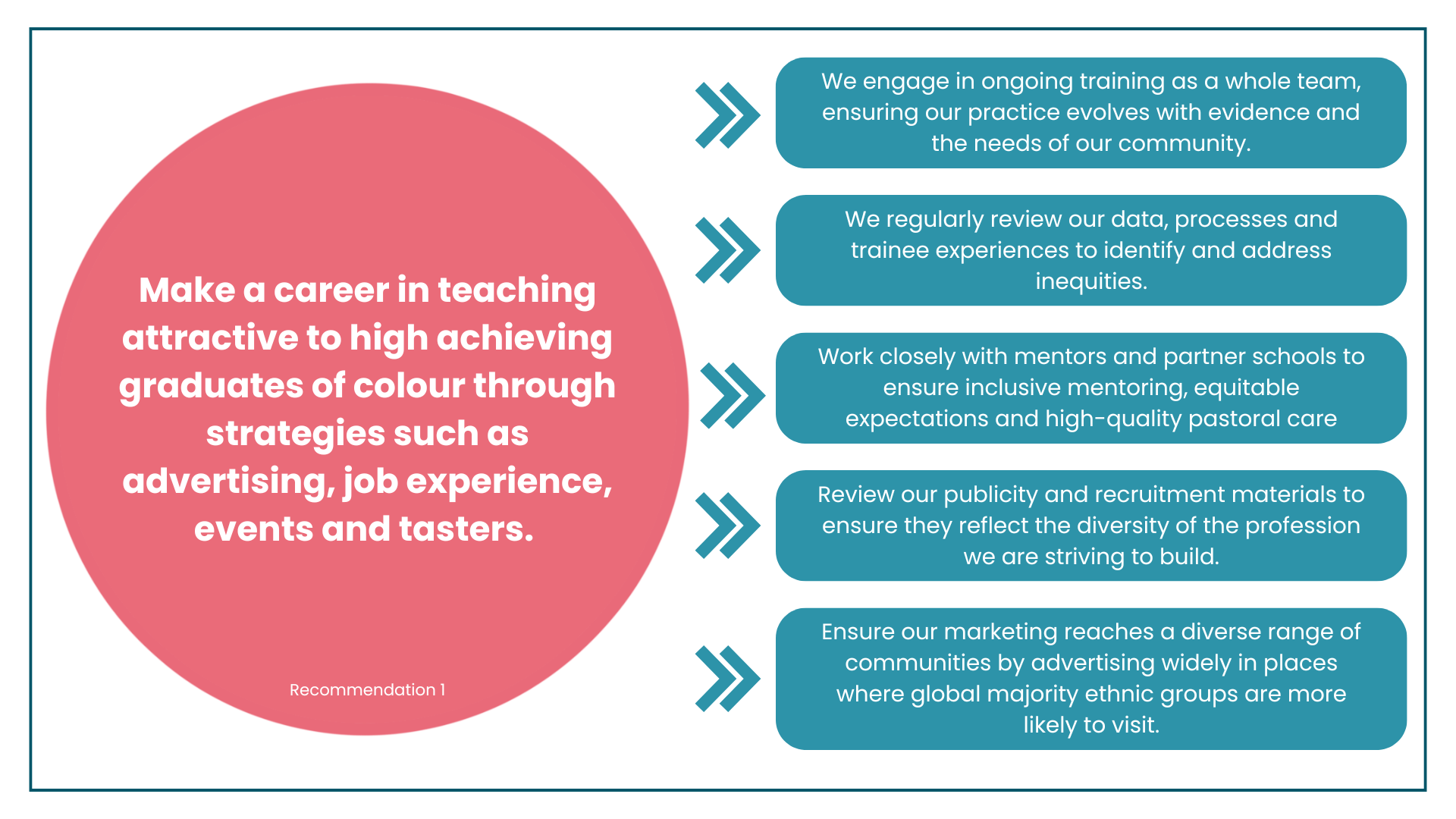
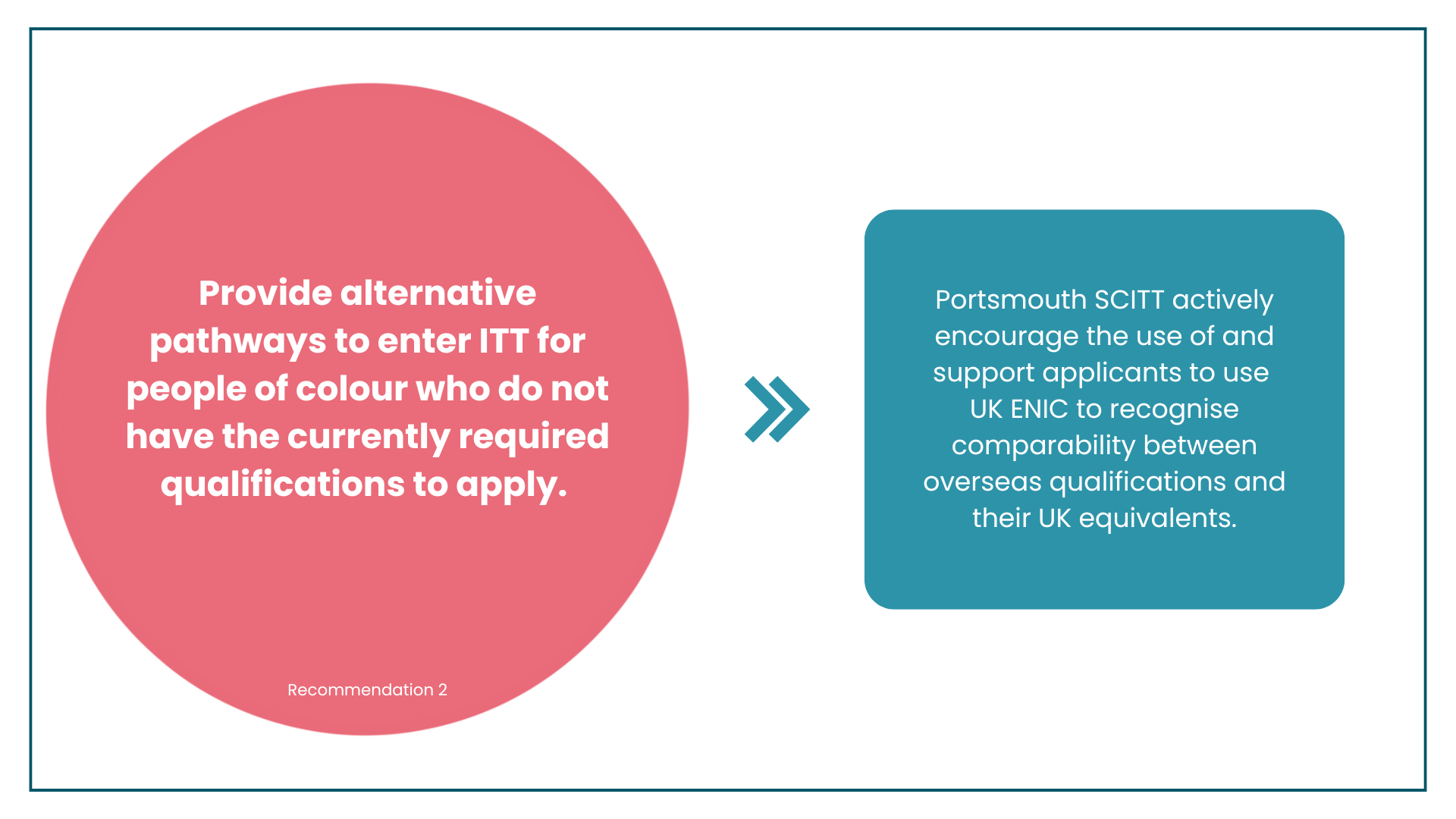
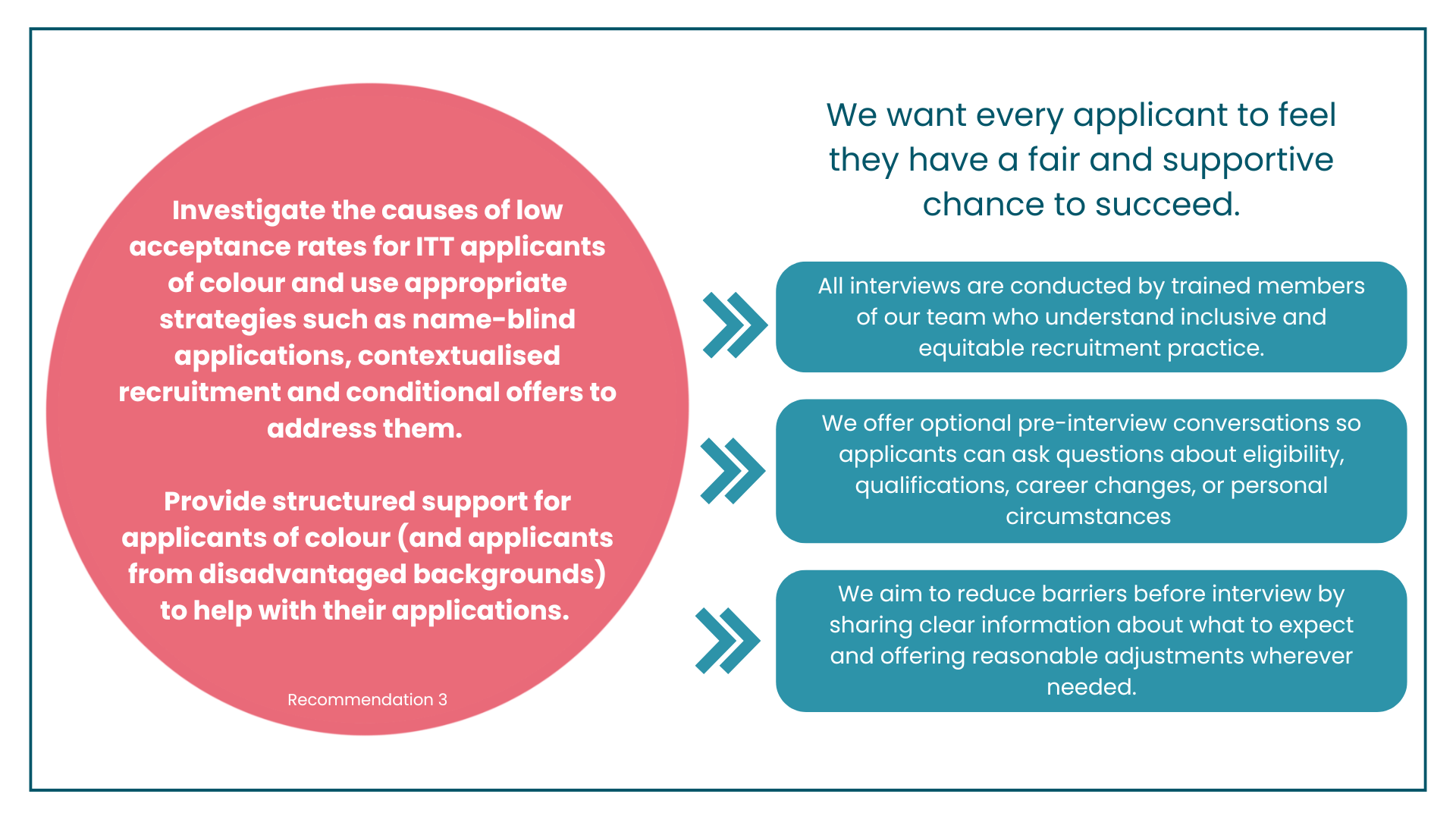
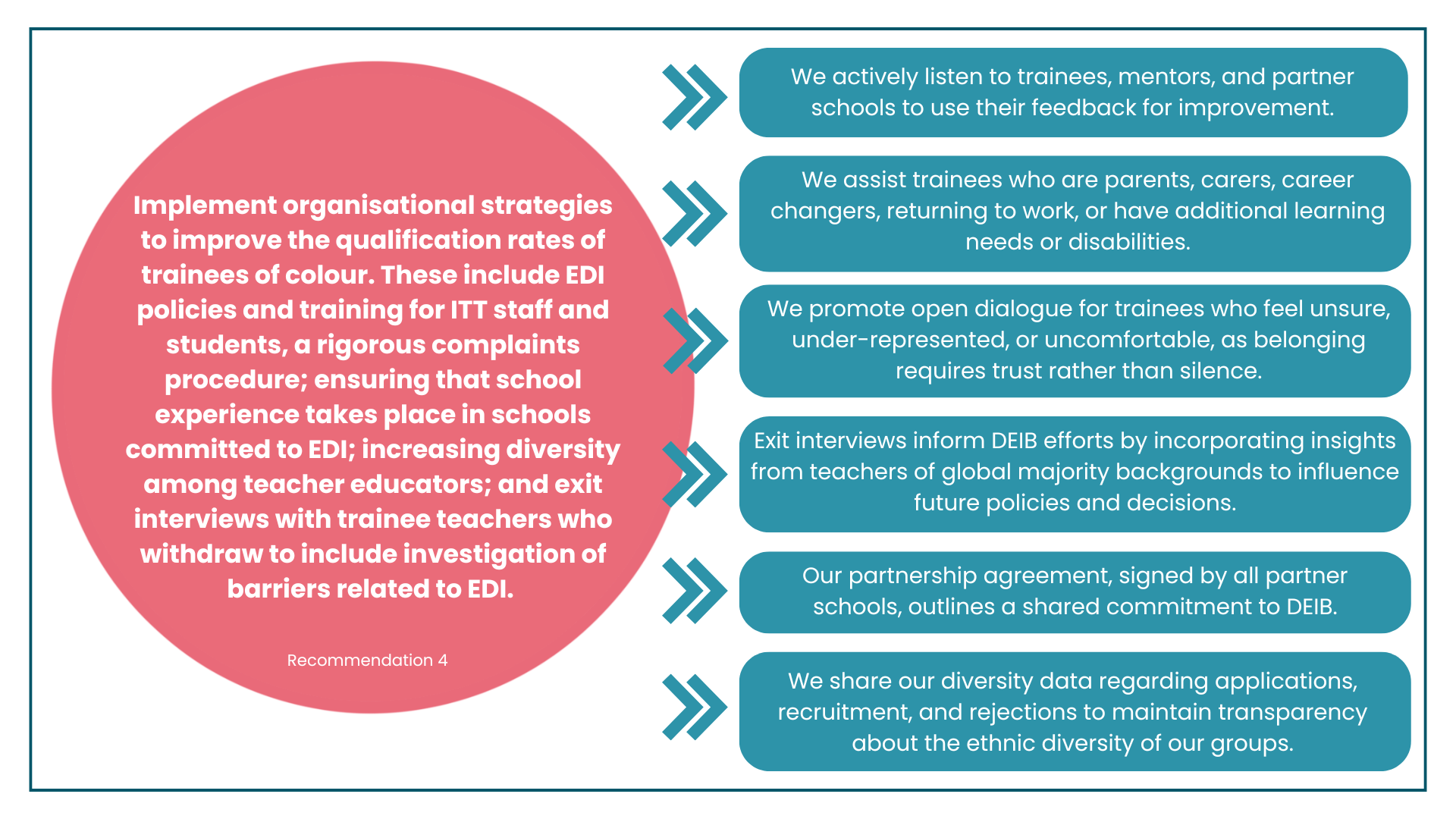
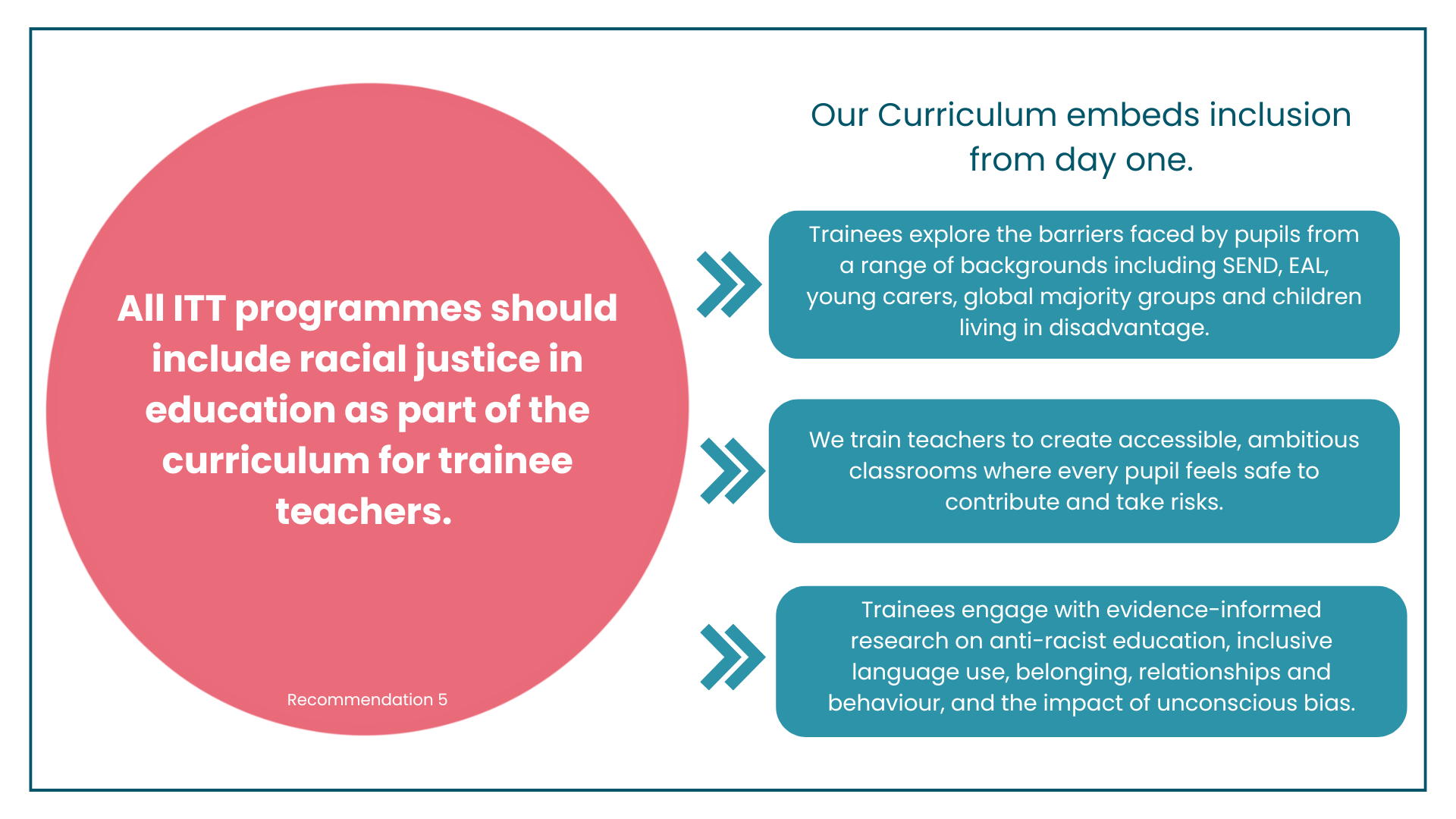
The report offered the following recommendations to ITT providers who are committed to tackling under-representation within the teaching workforce. They are listed below alongside the steps that Portsmouth SCITT have taken or plan to take in the near future.

Project Logo
The report states that, ‘Interventions in ITT must be a priority because this is the career stage with the greatest losses of people of colour from the teaching workforce. The following strategies are recommended in the literature.’ (NFER: Ethnic diversity in the teaching workforce: evidence review, 2024)
At Portsmouth SCITT, we refer intentionally to global majority backgrounds rather than terminology such as people of colour or ethnic minority. These commonly used labels can reinforce what is known as deficit language – language that positions certain groups as “less than,” “other,” or outside the norm. Deficit language focuses on perceived shortcomings or differences, rather than recognising the strength, richness and value that individuals and communities bring.
We avoid such terminology because it does not reflect our values or the diverse realities of the communities we serve. Using global majority instead acknowledges that these groups make up most of the world’s population, shifts away from deficit-based framing, and better aligns with our commitment to language that affirms identity, dignity and belonging.
This evidence from the NFER reinforces our responsibility as a training provider. Knowing that trainees from global majority backgrounds are disproportionately lost at the initial teacher training stage strengthens our resolve to act intentionally, listen closely and ensure our systems, culture and partnerships actively promote belonging, equity and long-term retention.
Recommendations for Initial Teacher Training
We are proud to be part of a sector working collectively to improve diversity and representation across Initial Teacher Training. Click on each recommendation to see how it is shaping our actions and priorities.
What next?
This is not a one-off project. It is a continuous journey of reflection, listening and action.
Over the coming months and years, we will be:
-
Refining our recruitment processes to reduce anxiety and increase transparency.
-
Strengthening mentor training to ensure every trainee is supported by an informed, inclusive educator.
-
Embedding more opportunities for trainees to discuss issues of identity, representation, and educational equity.
-
Expanding our outreach so that more individuals from under-represented and marginalised groups consider teaching as a fulfilling and accessible career.
-
Offering ‘third space’ coaching to trainees from global majority backgrounds where they can spend dedicated time with a coach with shared life experiences.
-
Working with our course alumni to evaluate where we have been successful and where we can do more to support diversity.
We want Portsmouth SCITT to be a place where every aspiring teacher feels they belong - and where future generations of children can see themselves reflected in the adults who teach, lead and inspire them.
An Invitation to Be Part of This Work
Our commitment to diversity, equity, inclusion and belonging is one we undertake as a partnership — staff, trainees, mentors, schools and alumni. We warmly invite everyone in our community to contribute to this ongoing work: by offering reflections, sharing experiences, engaging in training, and challenging us to improve.
We recognise, however, that the responsibility for creating an inclusive system must sit with the whole partnership. While the insights of those most affected by inequity are invaluable, we do not expect them to carry the burden of finding solutions. Meaningful change requires collective effort, active allyship and a willingness from all of us to learn, adapt and act.
At Portsmouth SCITT, we are committed to building an environment where every trainee feels seen, heard and supported — and we look forward to working together to shape a profession in which every child can recognise themselves in the adults who teach and inspire them.